
To make industry more climate-friendly, we must also take into account CO₂ emissions that cannot be completely avoided. Carbon Capture, Utilisation and Storage – CCUS for short – offers the possibility of capturing, utilising or permanently storing this CO₂. However, capture alone is not enough: for CCUS to work on an industrial scale, end-to-end CO₂ logistics are required. DB Cargo BTT is developing safe, flexible and scalable concepts for CO₂ transport to this end.

CO₂ logistics for Carbon Capture, Utilisation and Storage (CCUS)
We offer safe and scalable solutions for transporting CO₂ by rail
What does Carbon Capture Utilisation and Storage mean?
In sectors such as the cement and lime industries or waste management, certain CO₂ emissions cannot be completely avoided. These so-called ‘hard-to-abate’ industries require complementary solutions to achieve their climate targets.

CO₂ transport by rail: flexible and available at an early stage
A nationwide CO₂ pipeline network will only be established gradually, and not every industrial site will be directly connected. Rail can already provide initial transport solutions during the development phase. It utilises the existing rail infrastructure, flexibly connects decentralised industrial sites and can be expanded as volumes increase. In future, rail will become a central component of multimodal transport chains: it connects industrial sites with CO₂ hubs, ports and pipeline access points, whilst also serving routes without a direct pipeline connection.
How CO₂ logistics works
For transport, the captured CO₂ is liquefied and loaded into suitable, insulated tank wagons at around –30 degrees Celsius and a pressure of 12 to 15 bar (medium pressure „MP“). One wagon can hold around 60 tonnes of CO₂. DB Cargo BTT transports the CO₂ from the industrial plant to a CO₂ hub, port, pipeline access point or directly to a storage or utilisation site. There, it can be temporarily stored, transhipped or prepared for onward transport by ship or pipeline. This creates end-to-end multimodal transport chains.
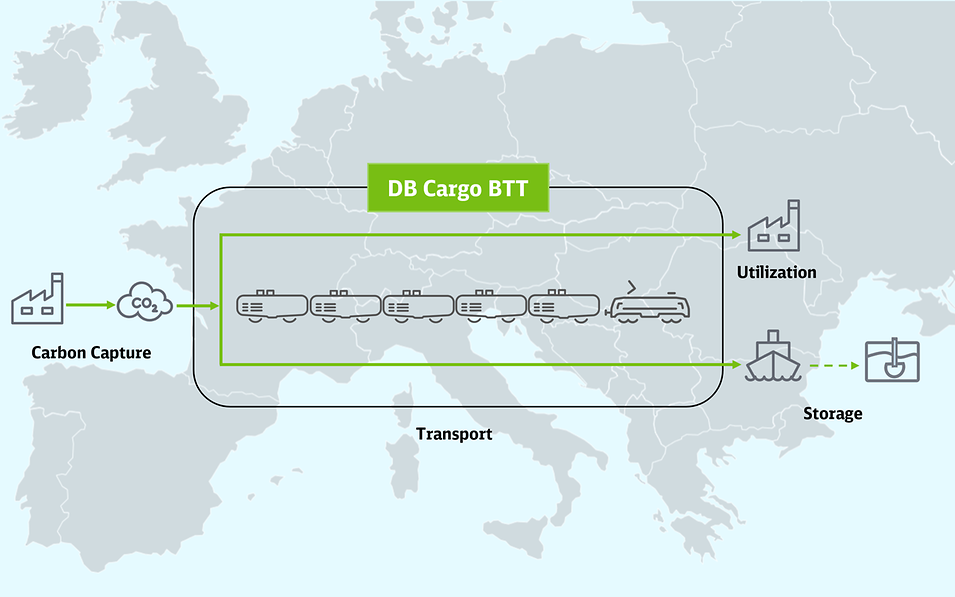
Our solutions for safe and scalable CO₂ transport
Every CO₂ transport chain presents different technical, operational and infrastructural requirements. DB Cargo BTT therefore works with its customers to develop tailor-made solutions for CO₂ logistics – from the initial project concept through to operational implementation.
These include, in particular:
- Analysis of CO₂ sources, destinations, routes and volume trends
- Assessment of railway sidings, loading facilities and transhipment points
- Development of suitable wagon, train and operational concepts
- Planning of multimodal, national and cross-border transport chains
- Development and expansion of transport capacity in line with demand
Safe and integrated into the European network
Safety is the top priority when transporting CO₂. DB Cargo BTT combines many years’ experience in dangerous goods logistics with DB Cargo’s European network. Coordinated safety concepts, standardised processes and clearly defined responsibilities form the basis for reliable national and cross-border connections – from loading through to handover at the storage or utilisation site.
Anyone wishing to capture, utilise or store CO₂ should plan the logistics at an early stage. DB Cargo BTT brings together technical and operational requirements and develops viable transport chains from initial project ideas.
Talk to us about your requirements for safe, flexible and scalable CO₂ logistics.
Get in touch with our expert.

Bjarne Regenbrecht
Project Manager CO₂ Logistics & Hydrogen Logistics


 Go
Go